 Add to Chrome
 Add to Firefox
 Add to Edge
LT2: Linear-Time Looped Transformers
May 20, 2026
Looped Transformers (LT) have emerged as a powerful architecture by iterating their layers multiple times before decoding the final token. However, pairing them with full attention retains quadratic complexity, making them computationally expensive and slow. We introduce LT2 (Linear-Time Looped Transformers), a family of looped architectures that replace quadratic softmax attention with subquadratic, linear-time attention. We study two variants: LT2-linear with linear attention and LT2-sparse with sparse attention. We find that looping uniquely synergizes with these variants: it enables iterative memory refinement in linear attention and progressively expands the effective receptive field in sparse attention. We formalize these benefits theoretically and demonstrate consistent empirical gains across controlled recall, state-tracking, and language modeling tasks. We then explore LT2-hybrid, which combines different attention variants in a looped setting. Two variants are especially promising: LT2-hybrid (GDN+DSA), which interleaves linear and sparse attention to maximize efficiency and matches the standard looped transformer's quality at fully linear-time cost; and LT2-hybrid (Full+GDN), which interleaves GDN with a small fraction of full attention layers to maximize quality, surpassing the standard looped transformer in both performance and efficiency. We also show how to convert a pre-trained LT into an LT2-hybrid model. With about 1B tokens of training, our converted model, Ouro-hybrid-1.4B, outperforms industry-level 1B models and is competitive with industry-level 4B models while retaining the speed benefits of linear-time attention. Together, these results show a clear path toward making looped transformers more scalable and advancing efficient, capable small language models.

Reinforcing Human Behavior Simulation via Verbal Feedback
May 19, 2026Humans learn social norms and behaviors from verbal feedback (e.g., a parent saying "that was rude" or a friend explaining "here's why that hurt"). Yet, learning from feedback for LLMs has largely focused on domains like code and math, where RL rewards are directly verifiable and condensed into scalar values. As LLMs are increasingly used to simulate human behavior, e.g., standing in for users, patients, students, and other personas, there is a pressing need to make them more human-like, which requires embracing a fundamentally different kind of signal: feedback that is verbal, subjective, and multi-faceted. We present DITTO, a model trained by treating verbal feedback as a first-class signal in reinforcement learning. After each rollout, DITTO receives verbal feedback and generates a feedback-conditioned improved rollout; both outputs are jointly optimized with GRPO, distilling verbal guidance into the base policy without requiring feedback at test time. We also introduce SOUL (Simulation gym Of hUman-Like behavior), a unified benchmark and training data suite spanning 10 tasks across six categories: Theory of Mind, character role play, social skill, learner simulation, user simulation, and persona simulation. DITTO achieves an average 36% improvement over the base model and exceeds GPT-5.4 on 6 of 10 SOUL benchmarks, demonstrating that RL with verbal feedback is a promising direction for training LLMs to simulate human behavior.
UFO: A Unified Flow-Oriented Framework for Robust Continual Graph Learning
May 11, 2026Graph learning research has increasingly shifted toward continual graph learning (CGL), which better reflects real-world scenarios where graphs evolve over time. However, existing CGL methods largely assume clean supervision and overlook a critical challenge: the newly arriving portions of the graph are often noisy, due to annotation errors or adversarial corruption. This mismatch limits their applicability in practice. In this work, we study robust continual graph learning, where models must simultaneously handle catastrophic forgetting and noisy supervision in evolving graph data. We show that label noise introduces a new failure mode, catastrophic remembering, where models persistently reinforce corrupted knowledge across tasks. To address these challenges, we propose a Unified Flow-Oriented framework (UFO). First, UFO models conditional feature distributions via flow-based generative modeling and produces replay representations, mitigating forgetting without storing historical data. Second, UFO estimates instance-level reliability scores to distinguish clean from noisy nodes, reducing the impact of corrupted supervision and alleviating catastrophic remembering. Extensive experiments on four benchmark graph datasets under varying noise ratios demonstrate that UFO consistently outperforms existing methods in both accuracy and forgetting metrics. Code is available at: https://anonymous.4open.science/r/UFO.
Self-Distillation Zero: Self-Revision Turns Binary Rewards into Dense Supervision
Apr 13, 2026Current post-training methods in verifiable settings fall into two categories. Reinforcement learning (RLVR) relies on binary rewards, which are broadly applicable and powerful, but provide only sparse supervision during training. Distillation provides dense token-level supervision, typically obtained from an external teacher or using high-quality demonstrations. Collecting such supervision can be costly or unavailable. We propose Self-Distillation Zero (SD-Zero), a method that is substantially more training sample-efficient than RL and does not require an external teacher or high-quality demonstrations. SD-Zero trains a single model to play two roles: a Generator, which produces an initial response, and a Reviser, which conditions on that response and its binary reward to produce an improved response. We then perform on-policy self-distillation to distill the reviser into the generator, using the reviser's token distributions conditioned on the generator's response and its reward as supervision. In effect, SD-Zero trains the model to transform binary rewards into dense token-level self-supervision. On math and code reasoning benchmarks with Qwen3-4B-Instruct and Olmo-3-7B-Instruct, SD-Zero improves performance by at least 10% over the base models and outperforms strong baselines, including Rejection Fine-Tuning (RFT), GRPO, and Self-Distillation Fine-Tuning (SDFT), under the same question set and training sample budget. Extensive ablation studies show two novel characteristics of our proposed algorithm: (a) token-level self-localization, where the reviser can identify the key tokens that need to be revised in the generator's response based on reward, and (b) iterative self-evolution, where the improving ability to revise answers can be distilled back into generation performance with regular teacher synchronization.
CLT-Forge: A Scalable Library for Cross-Layer Transcoders and Attribution Graphs
Mar 22, 2026Mechanistic interpretability seeks to understand how Large Language Models (LLMs) represent and process information. Recent approaches based on dictionary learning and transcoders enable representing model computation in terms of sparse, interpretable features and their interactions, giving rise to feature attribution graphs. However, these graphs are often large and redundant, limiting their interpretability in practice. Cross-Layer Transcoders (CLTs) address this issue by sharing features across layers while preserving layer-specific decoding, yielding more compact representations, but remain difficult to train and analyze at scale. We introduce an open-source library for end-to-end training and interpretability of CLTs. Our framework integrates scalable distributed training with model sharding and compressed activation caching, a unified automated interpretability pipeline for feature analysis and explanation, attribution graph computation using Circuit-Tracer, and a flexible visualization interface. This provides a practical and unified solution for scaling CLT-based mechanistic interpretability. Our code is available at: https://github.com/LLM-Interp/CLT-Forge.
Mind the Sim2Real Gap in User Simulation for Agentic Tasks
Mar 11, 2026As NLP evaluation shifts from static benchmarks to multi-turn interactive settings, LLM-based simulators have become widely used as user proxies, serving two roles: generating user turns and providing evaluation signals. Yet, these simulations are frequently assumed to be faithful to real human behaviors, often without rigorous verification. We formalize the Sim2Real gap in user simulation and present the first study running the full $τ$-bench protocol with real humans (451 participants, 165 tasks), benchmarking 31 LLM simulators across proprietary, open-source, and specialized families using the User-Sim Index (USI), a metric we introduce to quantify how well LLM simulators resemble real user interactive behaviors and feedback. Behaviorally, LLM simulators are excessively cooperative, stylistically uniform, and lack realistic frustration or ambiguity, creating an "easy mode" that inflates agent success rates above the human baseline. In evaluations, real humans provide nuanced judgments across eight quality dimensions while simulated users produce uniformly more positive feedback; rule-based rewards are failing to capture rich feedback signals generated by human users. Overall, higher general model capability does not necessarily yield more faithful user simulation. These findings highlight the importance of human validation when using LLM-based user simulators in the agent development cycle and motivate improved models for user simulation.
Combining LLM Semantic Reasoning with GNN Structural Modeling for Multi-View Multi-Label Feature Selection
Nov 19, 2025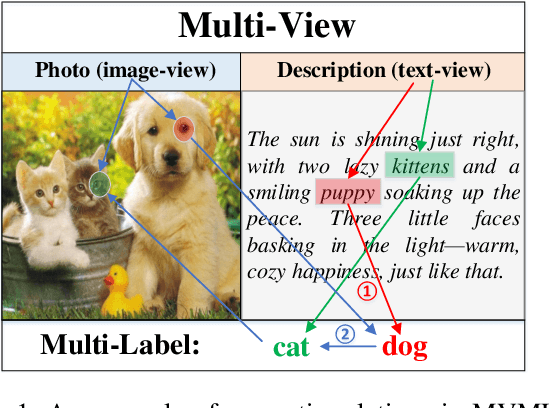
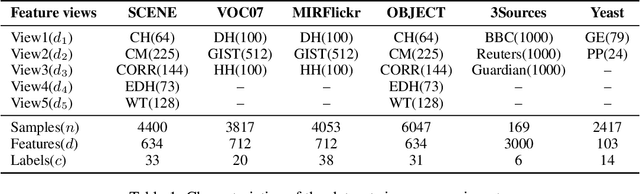
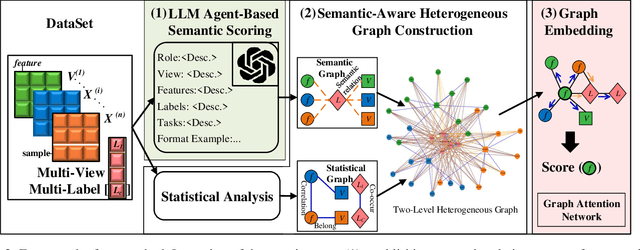
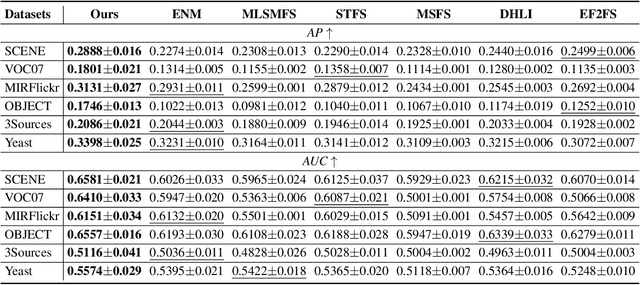
Multi-view multi-label feature selection aims to identify informative features from heterogeneous views, where each sample is associated with multiple interdependent labels. This problem is particularly important in machine learning involving high-dimensional, multimodal data such as social media, bioinformatics or recommendation systems. Existing Multi-View Multi-Label Feature Selection (MVMLFS) methods mainly focus on analyzing statistical information of data, but seldom consider semantic information. In this paper, we aim to use these two types of information jointly and propose a method that combines Large Language Models (LLMs) semantic reasoning with Graph Neural Networks (GNNs) structural modeling for MVMLFS. Specifically, the method consists of three main components. (1) LLM is first used as an evaluation agent to assess the latent semantic relevance among feature, view, and label descriptions. (2) A semantic-aware heterogeneous graph with two levels is designed to represent relations among features, views and labels: one is a semantic graph representing semantic relations, and the other is a statistical graph. (3) A lightweight Graph Attention Network (GAT) is applied to learn node embedding in the heterogeneous graph as feature saliency scores for ranking and selection. Experimental results on multiple benchmark datasets demonstrate the superiority of our method over state-of-the-art baselines, and it is still effective when applied to small-scale datasets, showcasing its robustness, flexibility, and generalization ability.
Redundancy-optimized Multi-head Attention Networks for Multi-View Multi-Label Feature Selection
Nov 16, 2025Multi-view multi-label data offers richer perspectives for artificial intelligence, but simultaneously presents significant challenges for feature selection due to the inherent complexity of interrelations among features, views and labels. Attention mechanisms provide an effective way for analyzing these intricate relationships. They can compute importance weights for information by aggregating correlations between Query and Key matrices to focus on pertinent values. However, existing attention-based feature selection methods predominantly focus on intra-view relationships, neglecting the complementarity of inter-view features and the critical feature-label correlations. Moreover, they often fail to account for feature redundancy, potentially leading to suboptimal feature subsets. To overcome these limitations, we propose a novel method based on Redundancy-optimized Multi-head Attention Networks for Multi-view Multi-label Feature Selection (RMAN-MMFS). Specifically, we employ each individual attention head to model intra-view feature relationships and use the cross-attention mechanisms between different heads to capture inter-view feature complementarity. Furthermore, we design static and dynamic feature redundancy terms: the static term mitigates redundancy within each view, while the dynamic term explicitly models redundancy between unselected and selected features across the entire selection process, thereby promoting feature compactness. Comprehensive evaluations on six real-world datasets, compared against six multi-view multi-label feature selection methods, demonstrate the superior performance of the proposed method.
Stabilizing Reinforcement Learning for Honesty Alignment in Language Models on Deductive Reasoning
Nov 12, 2025Reinforcement learning with verifiable rewards (RLVR) has recently emerged as a promising framework for aligning language models with complex reasoning objectives. However, most existing methods optimize only for final task outcomes, leaving models vulnerable to collapse when negative rewards dominate early training. This challenge is especially pronounced in honesty alignment, where models must not only solve answerable queries but also identify when conclusions cannot be drawn from the given premises. Deductive reasoning provides an ideal testbed because it isolates reasoning capability from reliance on external factual knowledge. To investigate honesty alignment, we curate two multi-step deductive reasoning datasets from graph structures, one for linear algebra and one for logical inference, and introduce unanswerable cases by randomly perturbing an edge in half of the instances. We find that GRPO, with or without supervised fine tuning initialization, struggles on these tasks. Through extensive experiments across three models, we evaluate stabilization strategies and show that curriculum learning provides some benefit but requires carefully designed in distribution datasets with controllable difficulty. To address these limitations, we propose Anchor, a reinforcement learning method that injects ground truth trajectories into rollouts, preventing early training collapse. Our results demonstrate that this method stabilizes learning and significantly improves the overall reasoning performance, underscoring the importance of training dynamics for enabling reliable deductive reasoning in aligned language models.
Taming Object Hallucinations with Verified Atomic Confidence Estimation
Nov 12, 2025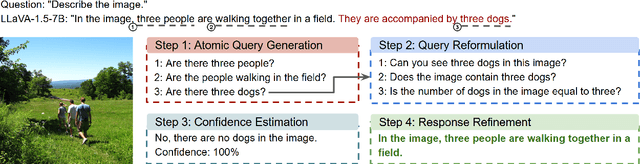
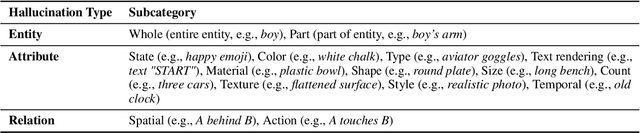
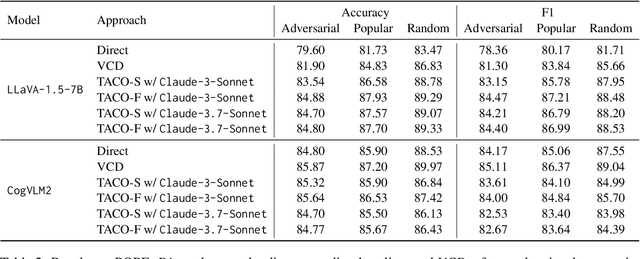
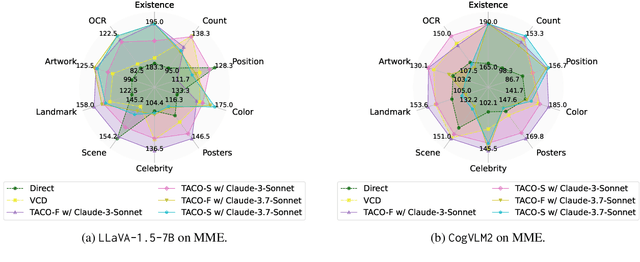
Multimodal Large Language Models (MLLMs) often suffer from hallucinations, particularly errors in object existence, attributes, or relations, which undermine their reliability. We introduce TACO (Verified Atomic Confidence Estimation), a simple framework that mitigates hallucinations through self-verification and confidence calibration without relying on external vision experts. TACO decomposes responses into atomic queries, paraphrases them to reduce sensitivity to wording, and estimates confidence using self-consistency (black-box) or self-confidence (gray-box) aggregation, before refining answers with a language model. Experiments on five benchmarks (POPE, MME, HallusionBench, AMBER, and MM-Hal Bench) with two MLLMs (\texttt{LLaVA-1.5-7B} and \texttt{CogVLM2}) show that TACO consistently outperforms direct prompting and Visual Contrastive Decoding, reduces systematic biases, and improves confidence calibration, demonstrating its effectiveness in enhancing the faithfulness of MLLMs.